
Make Hungary boring again?
Church-state issues will complicate the work of Hungary's new education minister

Hungarian media was full of recriminations and anticipatory rejections this week, as the country waited for Prime Minister Péter Magyar to announce his pick for education minister. On Friday, he finally revealed that education researcher Judit Lannert would lead a new Ministry of Education.
Magyar made the announcement in a special media appearance, a one-on-one interview the incoming PM himself conducted with Lannert. This was a stark departure. The other minister-level picks were announced with short speeches. In contrast, Lannert got a chance to explain her approach - focusing on creativity and critical thinking skills - in an extended one-on-one discussion. Magyar seemed to know that the whole country would be watching and anticipating this announcement.


Why such attention, even furor? To understand the controversy over the future of Hungary’s education system, it’s crucial to break down how Viktor Orbán’s Christian nationalist regime not only transformed state-manded curricula but, to borrow a phrase, “churchified” the system of funding public schools.
How did this happen? Who were the winners and losers of Orbán’s Christian nationalist educational system? Who should take center stage in any effort at public reconciliation, as Hungarian society figures its way out of Orbán’s authoritarianism? Read on to find out.
***N.b. This newsletter does not address Roma issues in education. Orbán’s system fostered racial segregation in schools among other injustices. I will cover that topic next week with an exclusive interview with Roma education activist and former Hungarian government official Gábor Daroczi.
Churchification of Hungary’s education system
Hungary’s new Education Minister Judit Lannert will face many challenges when she takes office on May 9, but none more vexing than how to fix church-state relations. If this sounds nonsensical - what does education have to do with church-state relations? - let’s do a quick dive into the Orbán regime’s education politics.
Starting in 2010, Orbán began a campaign to remake Hungary’s educational system. He started not with curriculum but real estate. He gave churches ownership of many high-performing schools. Between 2010 and 2021, the share of church-run kindergartens rose from 5.6% to 10.5%, primary schools from 8.6% to 16.6%, and high schools from 10% to 26.1%. Churches also took over summer camps and educational enrichment programs for talented youth, early childhood education centers, and even the infrastructure supporting Hungary’s foster care system.
The government then sent EU grant funds to renovate the buildings that housed these programs, while also boosting overall state funding to parochial schools. Today, church-run schools get more money and can rely on more stable funding, in contrast to cash-strapped state-run schools. Over the course of Orbán’s 16 years in power, Hungary’s two largest religious institutions, the Catholic and Reformed Churches, became major stakeholders in most aspects of Hungary’s public educational system.


Many observers have noted that by giving churches this windfall the government made them financially dependent. Orbán had the churches on a financial leash. Stay quiet about govrnment decisions or risk losing the massive government budget outlays. This was the seedy political underbelly to Orbán’s constant affirmations about church and public interests being one and the same.
For churches that run state-funded schools, Orbán also made frightening examples of the churches that spoke out against him. For years, the government ran a campaign to take over schools run by dissident pastor Rev. Gábor Iványi’s Methodist Evangelical Fellowship (MET). The government refused to accredit and fund the schools. Tax officials raided the MET’s offices claiming that the MET was violating the law by carrying excessive debt. (Of course, the MET wouldn’t have been in debt if the government had accredited and funded the schools.) Finally, last year the government took over these schools and then quickly transferred ownership of some of the confiscated properties to the politically loyal Reformed Church.
Sociologist Eszter Neumann has called this process “the churchification of Hungarian education,” a political project to outsource public education to politically and ideologically loyal religious organizations. It was one of Orbán’s signature policies and, as a result, opposition education activists like Lili Pankotai have made the separation of church and state in education into a rallying cry.
Protests and reprisals amid educational system decline
As a high school student, Pankotai rose to prominence as the face of the 2022 public mobilization in support of Hungary’s teachers’ union. Teachers and their supporters blocked roads and demonstrated for better pay. The government responded by targeting the protest leaders - not only Pankotai but also her family. Pankotai has spoken publicly about being beaten by the police and expelled from her school. Her family was nearly bankrupted by exorbitant government fines. In 2025, she appeared at a protest in Budapest and described these harrowing experiences, finishing with a provocative challenge to the government: “Shoot me first; I’m not afraid,” she repeated from the stage on Budapest’s Kossuth Square facing the parliament building.


This week, Pankotai was one of the first public figures to object when Rita Rubovszky was floated as a possible pick for Minister of Education. Rubovszky is a well-known Catholic educator. She helped oversee Hungary’s Cistercian school network. In fact, Pankotai was expelled from one of Rubovszky’s Cistercian high schools.
“I find it unacceptable that a secular institution like the Ministry of Education,” Pankotai wrote on Facebook, “should be headed by a person with these kinds of ties to the church that, together with [Orbán’s] Fidesz Party, has been shoveling money out of kindergartens, schools and universities.” She questioned whether Rubovszky could be impartial in case of a conflict between church and public interest.
After Pankotai’s post gained more than 1 million reactions on Facebook, Hungarian media covered the post as part of a society-wide conflict. “Péter Magyar’s move caused panic: left-wing influencers are terrified,” wrote one conservative online tabloid.
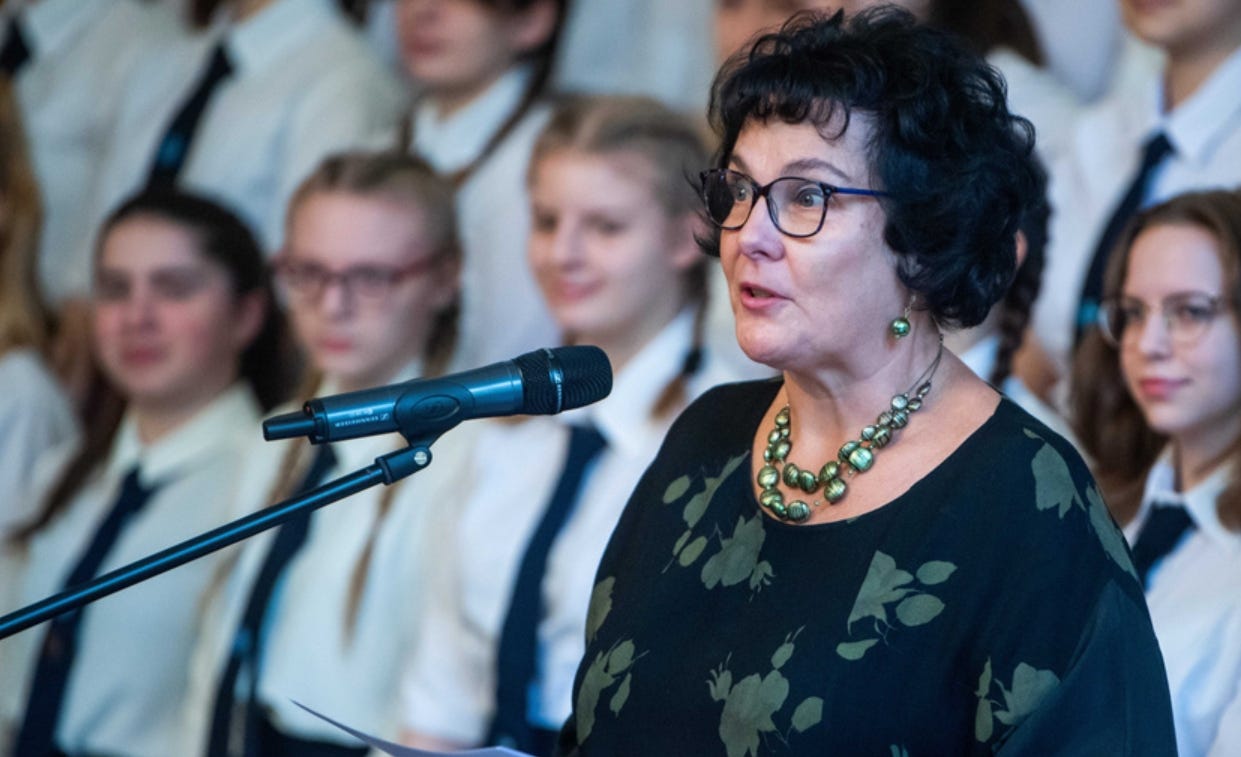
Magyar, a savvy politician, sensed that the stakes had gotten high and responded by setting aside extended time to defend his choice for education minister. But he also sensed a need to turn down the temperature. Lannert is a consummate professional and expert with many publications, academic honors, and successful research projects on her CV. She has led multiple Hungarian research institutes and has deep ties to Hungary’s intellectual community. She also has immaculate anti-Orbán bona fides. In 2023, she presented at Central European University, the university that Orbán targeted for political retribution and hounded out of Budapest in 2019.
But most of all, as became clear during her interview with Péter Magyar, Lannert is really boring. She said nothing remarkable while affirming widely held views about the social value of critical thinking and creativity. (Her research is about how to foster these skills in the classroom.) She said Hungary should meet European educational standards. She praised teachers who engage in critical thinking and said that the profession will die out if their voices go silent. Afterwards, Pankotai and other participants in the pre-selection ruckus signaled approval.
Just as crucial as the content was Lannert’s style. She spoke in lengthy sentences with frequent pauses. She strove to express herself carefully and precisely. Her tone did not waver; she radiated calm, steadiness, and seriousness above all. She waited until the interview’s 55th minute to smile.
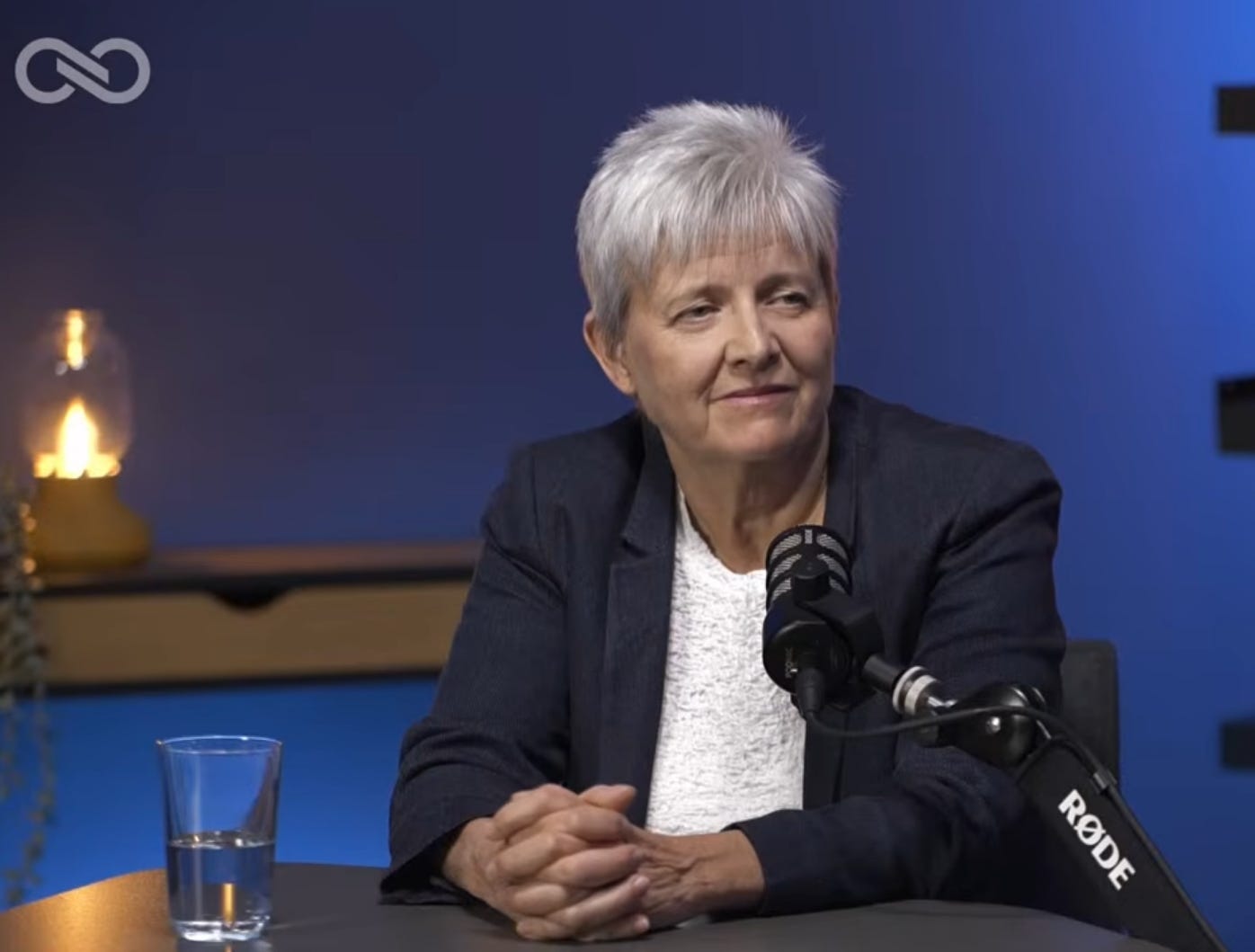
Her hands often remained on the desk, fingers intertwined, as she explained things like group research methodology. “Working together, we always proceed such that a research project that breaks new ground begins with studying lots of interview data, and that the creation of a synthesis is subsequent to repeated back-and-forth between the researchers. This is how a shared consensus emerges.” So boring, I nearly fell asleep translating this sentence.
But I think Péter Magyar preferred Lannert’s staid expertise not just out of immediate political calculus. After a decade and a half of Viktor Orbán raising the stakes ever higher and hitting a shrieking pitch about every possible threat to Hungarian society, maybe it’s time for boring. A return to normalcy, to borrow the American political phrase.
Curricular reform - focusing on critical thinking, not repetition of Christian nationalist dogma - will be the lesser challenge facing Hungary’s new education minister. Will the government try to disentangle the threads with which Orbán tied church to state during his tenure? This is the far more difficult question.
At a CEU panel of experts this week, political scientist András Bozoki suggested that the government might invite churches to voluntarily return some school properties to the state. But church institutions, like any institution, are self-interested. They will face pressure to keep good performing schools and hand back the bad ones in poor parts of the country. In Hungary, we could see a new public-private divide like the one that afflicts many part of the US, where private schools function to reproduce a ruling class of political and business elites while the rest get shunted into increasingly underfunded public schools.
And what will happen if the government decides to even out the funding disparities between parochial and public schools? Will churches complain if they suddenly get less funding, even if it’s just proportionally less than before? How will these complaints appear in the public conversation? In the US, we are all too familiar with accusations of government discrimination against religion and how politically conservative evangelical Christian groups have used these accusations to achieve particularist policy goals.
During the coming years, Lannert will have to keep up her unflappable demeanor. I hope that other stakeholders in Hungary’s educational system will respond with equal rhetorical charity and grace.
Hungary’s churches are engaged right now in a conversation about the deals they made with Orbán’s government and what future role they should play in post-authoritarian Hungarian society. So far, however, the conversation is pretty superficial. Here is one way to go deeper: Bring together people like Lili Pankotai and Rita Rubovszky for face-to-face discussions, maybe even a kind of truth and reconciliation storytelling process.
I say “people like Lili Pankotai” because, in fact, she is just the tip of the iceberg. Pankotai enjoys durable public authority because she stands for a vast group of exiles from church institutions. During Orbán’s reign, many Hungarians were forced out of church-owned social institutions for speaking out or somehow crossing Orbán’s government at an innopportune time. Churches mostly looked the other way.
Churches sacrificed their own rather than get tagged with a dissident reputation and risk the fate of Gábor Iványi’s dispossessed Methodist church.
There are thousands of Lili Pankotai’s who got forced out of church-owned, state-funded social service institutions - who had to switch jobs, endure salary cuts, or retrain in completely new fields. They are the losers of Orbán’s “churchification” project, and they should be front and center in any dialogue about ecclesiastical renewal after Orbánism’s fall.
Very helpful piece, thank you for providing all of the context!